Financial communities are fragmented
Discussion about a single stock or token is scattered across social platforms, chat apps, newsletters, data terminals and trading applications — none of which share context.
Robinhood Chain · Chain ID 4663 · Gas ETH
ConceptWallet-native social · Robinhood Chain



Room combines the open social identity of Farcaster, the community structure and voting mechanics of Reddit, and financial communities built around tokenized stocks and crypto assets.
“Room is not a trading platform disguised as social media. Its primary product is conversation, identity, discovery, and community coordination.”Room Principle
Why Room exists
A person discovers a stock on one platform, searches for serious discussion on another, joins a chat for updates, opens a fourth app for market data, and uses a fifth to act. Context is lost at every step, and the community owns none of it.
Discussion about a single stock or token is scattered across social platforms, chat apps, newsletters, data terminals and trading applications — none of which share context.
A wallet can hold stock tokens, crypto, access passes and collectibles, yet gives no readable identity, trusted reputation, membership or meaningful social graph.
Scammers copy project names, logos and moderator identities. Users often cannot tell an official issuer room from a fan group or a malicious imitation.
Analysts, educators, moderators and organisers create value, but subscription tools, payment platforms and social profiles are separate products.
Follower counts, engagement farming and paid promotion can outweigh accuracy. Financial discussion needs sources, disclosure, reputation and transparent moderation.
Many projects concentrate on launch-day activity and never build a long-term place for updates, governance, support, education and community-built apps.
When a platform changes its policies, closes an account or limits reach, the community has little control over its distribution. A community’s members, content, moderation history and reputation cannot move together — because nothing binds them to the community rather than to the platform.
What Room is
Room's long-term ambition is to become the social infrastructure through which people understand, discuss, organize around and build applications for onchain markets. It gets there in three stacked pieces.
The consumer social application — feeds, rooms, posts, replies, votes, research, and the interfaces around them.
Identity, community ownership, permissions, payments and portable social primitives, anchored on Robinhood Chain.
Tools that let third-party developers integrate Room identities, profiles, communities and actions into their own products.
Users should not need to understand blockchains to post, reply, follow or join. Decentralized components must improve ownership, verifiability, interoperability or payments — not add friction.
Basic profiles, public posts, replies, votes, follows and public rooms remain free. A project token is never required for basic participation.
Connecting a wallet must not automatically publish balances, holdings, transaction history or real-world identity. Users explicitly choose what to display.
Stock, token, creator, gaming, sports, education and general-interest communities are all first class. Tokenization is optional.
Room can show market information and community analysis, but must distinguish issuer information, third-party data, advertising, opinion and user research. It never promises returns.
Room integrates with wallets, data providers, launchpads, marketplaces and applications without letting any single integration define the brand.
Who it is for
Room's phase-one audience is narrow on purpose: Robinhood Chain builders, tokenized-stock communities, crypto project communities, market educators and analysts, and developers building mini applications.
The holder
A stock room shows verified asset identifiers, market context, corporate events, community sentiment and educational posts in one place. Trading stays optional and only through clearly disclosed integrations.
The application
Room's daily loop is small: open the feed, find a discussion, enter the room, read the context, contribute, follow or join. The interface below is that loop — a working prototype, not a screenshot.

Vlad
Joined August 2026
NVDAx
Tokenized stock
$184.22
▲ 1.84%
The product
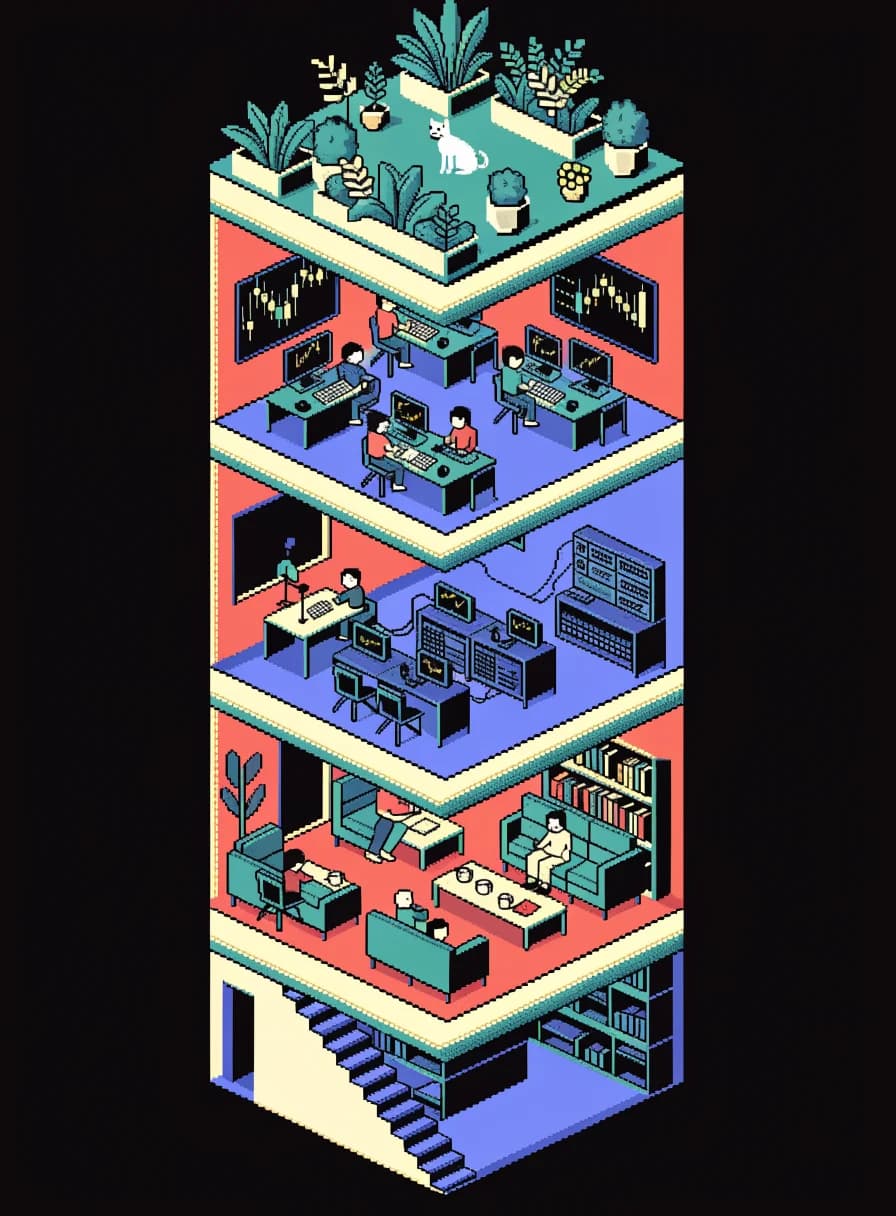
A room is not a hashtag or a chat group. Each one has ownership, roles, rules, feeds, permissions, treasury settings, economic features, integrations and moderation history.
Role changes for high-trust rooms should be recorded in an auditable registry. Routine moderation can stay offchain for speed.
Owner
Controls ownership and critical settings.
Administrator
Manages configuration and integrations.
Moderator
Enforces rules and handles reports.
Official Representative
Speaks for a verified issuer or project.
Analyst
Publishes labeled research.
Developer
Publishes or manages mini apps.
Member
Participates in the community.
Bot
Automated account with limited, visible permissions.
| Room type | Purpose | Example |
|---|---|---|
| Stock | Discussion around a stock or tokenized stock | NVDA Community |
| ETF | Discussion around an index or tokenized ETF | SPY Investors |
| Token | Community for a crypto asset | Project Token Room |
| Project | Product support and project updates | Protocol Builders |
| Creator | Creator-owned audience and content | Analyst Research |
| Theme | Cross-asset discussion | AI Stocks |
| Private | Invite-only coordination | Investment Club |
| Premium | Paid membership or content | Pro Research |
| Token-gated | Access based on an asset or credential | Holder Lounge |
| General | Non-financial community | Running Club |
Impersonation is one of the most common attack patterns in financial communities. Four labels, applied at the room level, are the front line.
Controlled or authorized by a verified issuer, deployer, project, or organization
Independent community with no official issuer claim
Ownership or asset relationship has not been verified
Strong risk signals or unresolved impersonation concerns
Verification may use
How Room makes money
Creators and communities earn from real services — subscriptions, tips, premium content, events, applications and memberships — rather than depending on token emissions. Room takes a share of those services, and nothing else.
Illustrative · axis 0–12%
| Product | Platform model | |
|---|---|---|
| Tips | 0–2% fee | |
| Creator subscriptions | 5–10% fee | |
| Premium rooms | 5–10% fee | |
| Event tickets | Fixed or percentage fee | not a percentage |
| Mini-app marketplace | Revenue share | not a percentage |
| Developer API | Monthly subscription | not a percentage |
| Sponsored discovery | Fixed campaign pricing | not a percentage |
All final fees should be clearly displayed before payment. These percentages are an illustrative model, not a fixed commitment.
USDG gives predictable pricing for social payments on Robinhood Chain. Membership is a non-transferable, onchain-verifiable state rather than a database flag, so access can be checked independently of the Room application.
An illustrative allocation framework — not a fixed promise.
| Use | Share |
|---|---|
| Product, infrastructure, and operations | 55% |
| Creator and community programs | 20% |
| Safety, moderation, and grants | 15% |
| Protocol treasury | 10% |
How it is built
Putting every post, reply, vote and notification onchain would create unnecessary cost, latency, privacy exposure and indexing complexity. Room records high-frequency social data offchain and anchors high-value ownership and economic actions onchain.
Content can be signed by user-controlled keys or authorized session keys, so the platform can verify authorship without an onchain transaction for every action.
IdentityRegistryProfile ownership root and wallet links.
UsernameRegistryUnique human-readable name ownership.
RoomRegistryCommunity ownership and critical settings.
RoleRegistryAuditable high-trust role assignment.
VerificationRegistryOfficial verification claims and proofs.
SubscriptionManagerRecurring creator and premium-room access.
TipRouterUSDG tip settlement and share splitting.
MembershipPassNon-transferable access status.
CommunityTreasuryRoom treasury actions.
AppRegistryMini-app publisher registry.
| Service | Responsibility |
|---|---|
| Authentication | Nonces, signatures, sessions, passkeys |
| Profile Service | Profiles, wallet links, privacy controls |
| Social Graph | Follows, blocks, memberships |
| Content Service | Posts, replies, media references |
| Feed Service | Ranking and personalized feeds |
| Room Service | Community settings, roles, rules |
| Moderation Service | Reports, actions, appeals, audit logs |
| Reputation Service | Topic scores and abuse signals |
| Asset Service | Verified contracts and market metadata |
| Payment Indexer | USDG payment and membership events |
| Notification Service | In-app, push, and email notifications |
| Search Service | Users, rooms, posts, and assets |
ROOM token
Room does not need a token for its MVP. Launching one before real usage exists distorts product incentives and attracts speculation before the network has proven its value.
No token exists, and none is planned before the gates below are met.
If ROOM is introduced later it should support product functions rather than gate basic social access. Basic profiles, public posts, replies, votes, follows and public rooms stay free either way.
None of the eight is met today — the documentation describes Phase 0 planning.
Roadmap
A phased path from prototype to protocol expansion. The project is at Phase 0.
Swipe to move through the phases →
Go to market
Room should begin with focused communities where identity, market context and wallet payments produce immediate value — and with a small group of founding creators and moderators recruited before public launch.
Open Room
No traditional account required.
Connect or create wallet
An EVM wallet, or an embedded smart wallet.
Sign authentication message
Sign-In with Ethereum: nonce, signature, session. No key is shared.
Claim unique username
A human-readable name such as Vlad.room.
Create profile
Display name, avatar, optional bio.
Select interests
AI stocks, dividend investing, crypto, gaming, development.
Join recommended rooms
Room recommends people and communities.
Enter personalized feed
A populated home feed in under two minutes.
Gas sponsorship and account abstraction may be used so new users do not need ETH before completing normal social actions.
Diligence
Five metric groups and ten named risks, each with the mitigation the design commits to. No live numbers are reported anywhere on this site.
| Risk | Mitigation |
|---|---|
| Empty-network problem | Launch with curated communities and founding creators |
| Spam and Sybil accounts | Rate limits, graph analysis, reputation, staged permissions |
| Impersonation | Clear labels, signed verification, domain and deployer proofs |
| Market manipulation | Disclosures, detection, transparent promotion, moderation |
| Wallet onboarding friction | Embedded wallets, account abstraction, gas sponsorship |
| Privacy concerns | Selective disclosure and private-by-default wallet metadata |
| Excessive onchain cost | Hybrid architecture and signed offchain content |
| Smart-contract exploits | Minimal contracts, audits, caps, timelocked controls |
| Regulatory exposure | Legal review, regional restrictions, careful product language |
| Token speculation distorting product | Delay ROOM until real utility and usage exist |
For developers
Robinhood Chain is an EVM-compatible Arbitrum Layer-2 with ETH as its native gas token, which is why standard Solidity contracts and Ethereum wallet libraries apply directly to Room's onchain components.
Mainnet
4663ETHhttps://rpc.mainnet.chain.robinhood.comhttps://robinhoodchain.blockscout.comTestnet
46630ETHhttps://rpc.testnet.chain.robinhood.comhttps://explorer.testnet.chain.robinhood.comContract addresses, asset registries and network settings must always be verified against the current official Robinhood Chain documentation before deployment.
An implementation recommendation, not a protocol requirement.
Questions
No. The documentation states Room does not need a token for its MVP, and that launching one before real usage exists can distort product incentives. If ROOM is introduced later it must clear eight gates first — including audited contracts, legal review, and clear supply, treasury and unlock policies.
No. Communities do not need a token to exist. Stock, creator, gaming, sports, educational and general-interest rooms are all supported. Tokenization is optional.
Creator subscription fees, premium-room platform fees, tip fees where appropriate, mini-app marketplace revenue share, professional community tools, premium usernames, developer API plans, verified organization services, labeled sponsored discovery, and enterprise community infrastructure.
Control or association — not investment quality or safety. It may use a deployer wallet signature, project multisig signature, official domain proof, issuer review, application key verification, or a signed statement from a previously verified identity.
No. Connecting a wallet must not automatically publish balances, holdings, transaction history or real-world identity. But Room must never imply a connected wallet's full history is private — public blockchain activity remains observable.
No. The documentation describes Phase 0 planning. No phase has shipped and no live or historical metrics are reported. This site is an interface concept built on that documentation.